
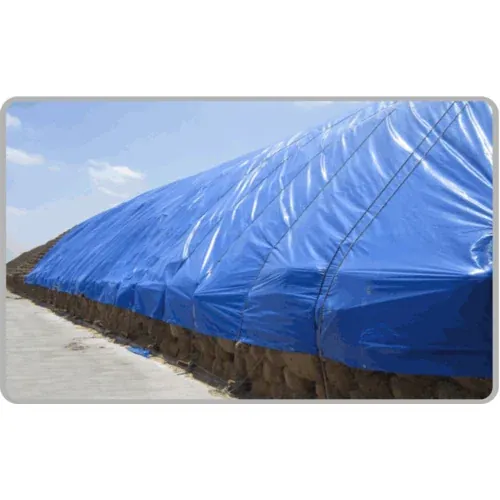
Every monsoon, tarpaulins go up over shop fronts, farm sheds, parking spaces, storage areas and work yards as temporary roofs. A good monsoon shed stays dry and stays up through the season; a poor one sags, pools water and tears in the first storm.
Build a frame with a slope
The sheet needs a frame, of bamboo, timber or steel, and the frame needs a slope so rain runs off. A flat roof lets water collect in pockets; the weight stretches the sheet, the pocket deepens, and eventually it tears or collapses.
Size the sheet with overhang
Measure the roof along the slope, not across the floor, and add an overhang on every side so rain drips clear of the shed and the edges can be fixed to the frame. Length needed = roof length + 2 × overhang; width needed = slope length + 2 × overhang.
For bulk orders we make tarpaulins in custom sizes. See how to measure and order tarpaulin.
Choose a heavy, UV-resistant grade
A roof takes everything the season throws at it: sun before the rain, heavy showers and strong wind. A heavy grade such as 200 GSM, multilayer and UV-resistant, is the safer choice. See our tarpaulin GSM guide.
Fix it so wind cannot lift it
- Tie the sheet to the frame along its reinforced edges, all the way round.
- Hold it down with battens or ropes across the top rather than nailing through the sheet; every hole is a leak and a place for a tear to start.
- Pull it snug so it cannot flap, and check the ties after every storm.
After the monsoon
Take the sheet down, wash off the dirt, let it dry completely and store it folded out of the sun, and it is ready for next year. More in how to make a tarpaulin last longer.
Our tarpaulins for monsoon cover
Our Indoline multilayer tarpaulins are made from bonded layers of mLDPE, LDPE and LLDPE: 100% waterproof, with a UV-resistant coating and reinforced edges, in 90, 120, 150 and 200 GSM, or any GSM from 70 to 200 on orders of 2 tons. See our multilayer tarpaulin specifications.